Perhaps it’s because of my work as a funeral celebrant or because of the different times I’ve walked the path of grief, but I find the unsolicited serving up of platitudes can demean a fellow human’s feelings.
Platitudes are the words we wear when we don’t know what else to say. Spiritually, platitudes are a paradox. On one hand, they act as thought-terminating clichés that bypass empathy and silence the suffering of the moment. They serve the speaker of those words, not the recipient. The ego helps us to ward off the uncomfortable. Retreating from someone else’s pain takes us away from being present.
We speak platitudes to hide the raw edges of grief or pain. And yet, beneath their veneer lies a universal truth—a desperate human desire to connect.
We offer them like sacred talismans:
Everything happens for a reason Time heals all wounds It is what it is
Perhaps platitudes were formed on the bedrock of collective human wisdom or even survival? We repeat them because we sense the seed of the universal human stories within them. The desire to connect with another isn’t the problem, of course, it’s the mindless recitation of words that don’t help another to heal.
To walk a mindful path, let us swap the easy answer for the heavy, beautiful act of sitting with someone in the dark. Unsure how?
Instead of saying They are in a better place perhaps you could say:
I am holding space
for the massive absence left behind.
Everything happens for a reason dismisses a person’s pain. How about saying:
This is deeply unfair,
and you do not have to find a lesson in it.
God doesn’t give you anything you can’t handle does not help a person. Why not support them with:
You shouldn’t have to be this strong right now.
I am here in the weakness with you.
When someone’s future is uncertain, you might be tempted to soothe things over with words like: It will all work out in the end. Or, you could enter into presence and say:
I don’t know how this unfolds,
but you will not walk through the unknown alone.
If you find yourself in the company of someone who is suffering deeply, instead of telling them to be positive or cheer up or look on the bright side, you could say:
I am ready to sit with you in the dark
for as long as it takes.
Sent with warmth and compassion from my writing desk in the wild fells of Cumbria,
Veronika Sophia Robinson
Author, Novelist, & Weaver of Word Medicine If this blog touched your heart, you are warmly invited to step further into my literary sanctuary. Explore the complete collection of fiction and non-fiction books at Starflower Press, or discover the living map of your soul with a personal reading at The Oracle. My celebrant training and celebrant masterclasses can be found at Heart-led Celebrants.
https://veronikarobinson.com/wp-content/uploads/2014/08/singlecosmos.jpg585585Veronika Sophia Robinsonhttps://veronikarobinson.com/wp-content/uploads/2025/04/Updated-logo-colour.pngVeronika Sophia Robinson2026-06-11 07:05:182026-06-11 07:12:32Sitting in the Dark: Why Platitudes Fail Us in Grief
Today’s the one-year anniversary since my beautiful mother slipped from this earthly life. A year that feels like a day while also feeling like a hundred years have passed. How is that? What delusion does grief spin? I’ve just been on a video call with two of my brothers, and shared the disbelief that a whole year has passed by with such speed.
This photo is from the last time mum came to England and stayed with us for a few months. I keep it on my fridge. And when I think that beautiful woman is now ‘dust’, it shocks me every single time.
Grief steals many things. Most of them are quite obvious, but the one we don’t talk about is the poaching of time. I’m in a time warp, and more conscious of my own mortality than I’ve ever been. Time is slipping away. With my 60th birthday next year, already I’m thinking ‘why bother’ about so many things from the mundane ‘necessary’ dental work to life-enhancing dreams. What’s the point, I wonder. I’ll be dead soon enough anyway. I feel as if I’m already slipping away from this life.
Mum with me on my wedding day
Not everyone loves their mother or holds her in such high regard as I do mine, I know that. Not everyone whose mother has died will relate to what I’m sharing. What I do know, though, and what is true for me, is that even a year later this grief feels so hard. When I walk by my mother’s photos, it stops me. That beautiful smile. My mama. The woman who held me, bathed me, dressed me, played games with me, made (and still makes) me laugh with her sense of mischief. The woman who inspired me like no other. And then I think of the reality: her physical body, the one that loved me so much, is nothing more than cremains (cremated remains). How it that possible? And with that question lurks the one that plays on my mind every single day now. What is the point of anything?
I often think of my mother’s life, and all her joys and sorrows, creativity and obstacles, loves and losses. All the hard work, all the years raising eight children, all the… And now she’s gone. I know this applies to every human who’s ever come to this Earth, but this high-definition imagery of my mother living her life, and then gone, just ‘gets’ me in a way nothing else in my life ever has. I grew in her womb. I was one with her. If she’s ‘gone’, then where and who am I?
Mum outside the little hut she built on Mt. Arthur in Tasmania.
Everything I’ve believed in for so long, different spiritual ‘ideas’ and practices, are now almost meaningless. I beg the Universe to answer me: do I have free will or am I just a puppet on a string? I don’t want to be a puppet on a string, I yell. I’m not your toy! Of course, I don’t know the answer. What I do know, is that I’m questioning things that have long been my mainstay, my inner truth. Sometimes I look at all the books on my shelves, those portals into knowledge and wisdom, that I’ve valued for deep esoteric teachings and as each day passes, I’m tempted to burn everything. Nothing gives me any answer as to human suffering. Mine or that of other people.
With my mum when I was about 21.
The first time I ever saw my mother cry was when I was about ten, and she’d found out her mother had died. My grandmother lived in Germany, and I never had the privilege of meeting her though I loved to write and receive letters from her. But those tears my mother shed? I only wish I could have held her in the way I’ve needed holding. The grief she’ll have felt, not to mention regret at living overseas far away from her for a couple of decades, will have been unbearable. And I’ve no doubt that she, like me, will have also felt grief for the losses in her mother’s life.
My mother’s mother
The mother-daughter bond (for better or for worse) is unlike any other relationship. Sometimes daughters think that difficult relationships with mothers are better served by estrangement. This is not true, and death will wallop just as hard, if not harder, than for those whose relationship was less complicated.
My mother’s eight children, in age order. Left to right: Wolf, Heidi, Horst, Veronika, Ramona, Cam, Rene and Albert reunited for our father’s funeral.
The death of a loved one changes us. I mean, it has to, right? Otherwise, what’s the point of going through that emotional torture? Perhaps my torture has been amplified by the nature of the work I do as a funeral celebrant whereby I walk alongside people in their grief. The weeks leading up to and after my mother’s death were unlike anything I’d experienced before as a funeral celebrant (even though I’ve had extremely difficult funerals, such as child funerals and officiating my best friend’s cremation service and later, her memorial). What made them so hard was that each time I said the words of committal for someone’s mother, or read a tribute that said “I love you Mum. You’re my best friend,” or had to listen to music with the lyrics “You gave me my name and the colour of my eyes,”, I would just die inside. My mourners had no idea what was happening in my private life. The day my Mum died, I had to work. Several months earlier, I’d organised to host and facilitate a retreat for funeral celebrants on creating beautiful bereavement ceremonies. The irony! There was no calling it off. Not only had I been officiating funerals all the way up to my mother’s death, I then had four days of intense focus on teaching about grief. And then straight back to funeral work. I don’t share this for pity (that never helped anyone anyway), but because the reality is this year has challenged me on many levels, personally and professionally.
My role as a funeral celebrant has never felt so difficult as it has in this last year.
Maybe I’ve just not had enough space to step into ‘grief-free’ happy spaces for long enough to enable some recalibration. Apart from my mother’s death last year, the only other thing I remember with any clarity was a week away in the Scottish Highlands walking the Great Glen Way with my friend Angela. When I replay some of the videos we made, it makes me smile to see how much laughter we shared. I yearn for my life to be filled with that sort of belly-aching laughter and joy all the time. Everything else about 2025 is a blank. This past year has been like walking through the thickest fog I’ve ever known. What are you meant to do in fog? The high beam doesn’t work. The low beam doesn’t work. How am I supposed to see my way forward? Despite my spiritual beliefs, this grief has been unlike anything I’ve ever experienced. There are still so many moments where I see a lovely card somewhere and think “Oh, I’ll get that for mum.” And then that realisation a few seconds later… Or when her birthday and Christmas came around, and ‘reminder’ emails from the florist I used to use to send her flowers land in my inbox asking me if I’d like to order a bouquet. A horrible reminder that I’ll never, ever, ever, ever again have the pleasure and privilege of brightening her day with flowers. That hurts.
Me and my mum
I’ve known grief a number of times now, but the most significant ones have been those of my parents and best friend Pam. This coming Christmas Day will mark ten years since Pam chose to end her life. At no level of my being is it possible to believe that a decade has gone by. I’m past that stage of thinking “I must tell Pam…” but I do have times where I see someone in the street who maybe had the same hair cut or dress style, and I think “Oh, there’s Pam!” Those moments are akin to being hit by a truck. I gather myself before the tears start. And then there are the funerals I officiate where they have one of the pieces of music we had at her funeral. I walk up the aisle of the crematorium just wanting to curl into foetal position.
Next month, on the equinox, it will be fourteen years since my father was killed in a car crash in Australia. My father’s death has integrated a bit more, finally, but I can still have tears turn up from nowhere. That he died aged 77, the age my husband is now, nags at me.
For the uninitiated into grief, anticipatory grief can be harder than when we experience a sudden death. Yes, sure, we get a chance to say goodbye but we’re also grieving twice. Before and after. While we’re waiting around for them to die, we’re grieving for tomorrow. The tomorrows where they won’t be there. And even when you’re expecting it, somehow nothing prepares you for the moment. The moment when… For me, just knowing my mum was still alive, her heart beating strong as an ox, even when deep in coma, right to the last beat somehow lulled me into a sense of hope. Where there’s life there’s hope, right? I was wrong. Despite the ridiculous amount of crying I’d done in the previous two months, when my brother phoned me during the night, UK time, to say she’d died, it hit me hard. She’s gone.
Hopefully she’s dancing with my father again
I’ve spoken sternly to the Universe and have made it quite clear that I’m in no shape to receive any more grief, thanks. And yet, I look at my family (I’m one of eight children) and friends and think “fuck, unless I go first, I’ll be saying goodbye to you too”. With that, I’m flicking pesky tears off my cheeks. “No,” my heart says. “Just NO!” I think of their beautiful faces and loving hearts, and I just can’t imagine them not being here in that form anymore. And yet, despite that, I know that death is a change of form. Nothing ever really dies. But grief doesn’t want me to know that. Grief says “How many ways can I pull at that heart of yours or bring up memories you’d long forgotten?”
I realise that it might seem I’m indulging and wallowing in self pity. Maybe I am. Or maybe it’s because, dear reader, that we live in a grief-illiterate culture and people just want the bereaved to crawl under a rock and shut the fuck up so that they don’t darken anyone else’s day. That’s how it feels. I know that, apart from work, I’ve become even more of a hermit than ever before. Life feels kinder that way. There’s no risk of someone saying something which stings, like “I don’t need to offer you condolences because of your strong spiritual beliefs.” Or, “Are you over your mother’s death yet?” I WILL NEVER BE OVER MY MOTHER’S DEATH! And, as I say that, I’m also happy that she is out there, as stardust, at one with the Universe. She’s exactly where she wanted to be: in her light body.
The children’s book my mother wrote and illustrated.
Grief the gift-giver Perhaps if you don’t know me well or at all, it might be hard to believe that I am, by nature, an optimist and grateful about my life, even though I’ve felt like a shadow of my former self this past year. What hasn’t changed is the way I start each day where I give thanks for my beautiful life. I’m grateful that practice hasn’t changed. When I take myself off for walks in the woods, I give thanks that I live in such a beautiful part of the world and have a working life that affords me freedom to walk in between pockets of writing time. This is one of my liminal spaces. Perhaps grief, too, is a liminal space and that I will emerge. I wonder who that person will be because she certainly won’t be the one who entered.
No matter what Life brings our way, everything has to have an upside or positive learning that can be taken from it, otherwise, what is the point of any of this?
Grief has brought gifts. Strange, but true. I’ve always been grateful for my upbringing even if I wasn’t always grateful for my parents at certain times. Truth is, when we’re kids, our parents can be annoying or authoritative. We become teens and they’re downright embarrassing. We become adults and think we know more than them and see their flaws as if they’re emblazoned on their forehead.
And. Then. They. DIE.
And we become an orphan. I’m not only speaking for myself, now, but all the mourners I’ve worked with of various ages who are hit hard by this reality. Even at 70, it’s like the Universe just pulled the rug out from under them. The idea, the reality, that our parents are gone is inconceivable.
We always hope our own children will understand the fragility of life and that their parents won’t always be around. That maybe, just being that bit kinder wouldn’t hurt them. That accepting their parents are human, is part of growing up. Because all those things we bitch about in relation to our parents, become utterly meaningless when we can no longer phone them and hear their voices.
Tucked into an alcove in my bedroom are photos of my mum, in the prime of her life, sitting on the swing in our garden and smiling; and my dad, as a young man, playing his piano accordion. No matter how many times I walk into my bedroom during the day or night, I pause at that altar and say ‘thank you’. I blow them kisses and say “Thank you for giving me the most incredible childhood. Thank you for the sacrifices you made. Thank you for modelling creativity, strength, resilience and adaptability. Thank you for being my parents.”
I wish I hadn’t needed grief to reach this level of gratitude.
My mother passed away at the New Moon in Pisces, releasing her last breath at 11.11a.m. on February 28th 2025 in Queensland, Australia, with her first-born child by her side. There was a lovely planetary line up.
This photo of the sky was taken on the day my Mum died by my brother Cam. Each time I look at it I can see my mother skipping up those planets, like a ladder to eternal bliss. Perfect.
I’m grateful that today there’s also a rare planetary line up. The timing is perfect.
I grieve that I wasn’t with her in those last months and years. I am grateful, however, for having known my mother’s love. A love like no other and completely irreplaceable.
https://veronikarobinson.com/wp-content/uploads/2025/10/wolfgang-hasselmann-w_l4K0oyEyY-unsplash.jpg12851920Veronika Sophia Robinsonhttps://veronikarobinson.com/wp-content/uploads/2025/04/Updated-logo-colour.pngVeronika Sophia Robinson2026-02-28 11:26:532026-02-28 12:15:04Grief the Time Thief and Grief the Gift-Giver
Festive Grief. It seems odd to put the two words together and yet the reality is that you or someone you know will experience grief during what is considered to be the ‘happiest time of the year’.
Christmas Eve 2016 In the tradition of my German ancestors and ancestresses, I always celebrate Christmas on Christmas Eve. In 2016, as I watched the lights twinkling on the Christmas tree and relaxed with my family, I reflected on what a fabulous year it had been. We’d become grandparents for the first time. The year was also lovely because it wasn’t defined by anything awful and upsetting. Five years earlier, my husband had suffered a heart attack, and the following year my father was killed in a car accident in Australia. 2016, in comparison, seemed like a breeze! And the year got bonus points for bringing us such a beautiful granddaughter. I love Christmas: stollen, lebkuchen, twinkly lights, celebrating by candlelight, delicious meal, family. My mother had always made it such a beautiful and special time in our family and I hold this time as sacred. Every memory I had of Christmas was wonderful.
But, you know, nothing ever stays the same for long. That’s the nature of life and being human.
Christmas Day 2016 The morning of Christmas Day my best friend of 18 years was found dead in her charming Cumbrian cottage. I’ll spare you the details other than to say she chose to end her life. I should probably add that she hated Christmas. (Her father had died, when she was a child, the week before Christmas. 2016 was the 40th anniversary of his passing.) Over the years she’d spent a number of Christmas Eves with me and my family (I was always trying to rewrite her script and show that Christmas could be lovely! She ended up rewriting mine!)
As we approach the seventh anniversary of her passing (something I can’t even comprehend), I’m aware that this is the first Christmas I feel Christmasy and actually feel like celebrating. I even had the tree up by December 3rd. Most days since, I’ve been singing along to Christmas tunes. I was always a 1st December-get-that-tree-up sort of girl and played those carols non-stop till my birthday on the 28th. During these years since her death, I can’t even begin to imagine how unbearable I must have been to be around. My heart was heavy. It was as if I was a shadow of my former self. This death changed me. How could I ever celebrate Christmas again? It was ALWAYS going to be the anniversary of Pam’s death. A death that was chosen. What sort of friend was I to have let this happen?
When I put up my Christmas tree the other day, some of decorations which I placed were ones Pam had given me. Did I cry? No. I smiled. “Thank you Pam,” I said. In that moment I felt nothing but joy that she’d been in my life; and, in her own way, was with me for Christmas. She’ll know, more than anyone, that come Christmas I’ll have a moment in private somewhere to shed a tear or two (or twenty!) in remembrance. For better and for worse, she is forever more inextricably linked with Christmas.
It’s inevitable as the years pass that there’ll be more deaths in my life which will add to the various layers of grief that I live with, and they too will become part of my Christmas story (hopefully not in the dramatic way that Pam chose).
I know a thing or two about grief, personally and professionally. In my years as a funeral celebrant I have walked beside those whose hearts were blown apart by grief. For some of them, the death of their loved one happens close to Christmas. For others, this time of year is also the annual reminder that they won’t be sharing a festive meal or gifts under the tree. The Christmas-time ceremonies I’m asked to officiate have such an added gravity to them. I usually come home to bed afterwards and cry for the family.
What have I learnt? Only this: No one can tell you how to grieve or when to grieve. Even though well intentioned, NO ONE knows how you’re feeling. It’s an impossibility. The relationship you had with your loved was unique to you. People who aren’t grieving can find it rather an inconvenience that you’re not ‘on top of things’. I certainly learned who I could count on and who wasn’t able to hold space for me (pretty much everyone).
Be kind to yourself. Grief never ends but the way you live with it does. Do whatever you need to do to walk through this season with all its festivities, bright lights, fun and laughter.
Step back without apology. Decline invitations if that feels right. Do not feel obligated to take part in any Christmas traditions.
If you can, though, accept the love of those who are kind enough to offer it. In my darkest moments, the hugs from a loved one held me when I couldn’t hold myself. Sometimes we just have to lean into another. And if you don’t have anyone, lean against a tree. It might sound daft, but try it. Trees are strong. They’re rooted. They aren’t going to go anywhere, and they’re not going to turn you away. Nature is a balm.
What you might like to do is:
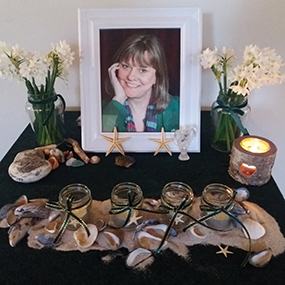
Place your loved one’s photo/s under the tree (if you’re having one) or somewhere they are visible
Talk to them as if they were in the room with you (no, you’re not going mad)
Create a new ritual that includes them in your festive season
You might like to have a bespoke decoration made with their photo or name so that it is visible each year.
Time doesn’t heal. (Whoever said ‘time is a healer’ clearly hadn’t yet been kicked in the guts by grief!)
Time does make things feel, shall we say, a little softer. But how long that takes isn’t something any of us knows until it happens.
Veronika Robinson has been officiating beautiful, bespoke ceremonies since 1995.
As a funeral celebrant, she officiates ceremonies across Cumbria and into Scotland, Lancashire and Northumberland. She is a certified Infant Loss Professional; founder of Penrith’s first Death Café; is a celebrant for the charity Gift of a Wedding. Along with her husband, Paul, she’s a tutor at Heart-led Ceremonies Celebrant Training
Veronika is the author of many books including the popular Celebrant Collection: Write That Eulogy; The Successful Celebrant; Funeral Celebrant Ceremony Planner; Wedding Celebrant Ceremony Planner; The Blessingway. Three more titles will be added in January 2024: The Gentle Celebrant’s Guide: Funerals For Children; The Discrimination-free Celebrant; The Celebrant’s Guide to the Five Elements.
Grief, Gluttony, Giving, Gratitude. Our experience of Christmas tends to fall into one or two of those areas.
Christmas has always been a cherished time in my life, made magical by parents who brought the festive season alive with enchantment and mystery. The Germanic tradition my parents passed onto me is something I still honour. And so, I celebrate on Christmas Eve by candlelight with a lovingly prepared meal and gentle time with my loved ones. This, to me, is Christmas. It’s based on simplicity, love, beauty, and kindness.
As children we would gather by the tree (one grown on our land), the scent of pine infusing the room as we sang Christmas songs in both German and English. To celebrate Christmas was to cross the threshold into another world: it was, indeed, ceremonial, and imbued with ritual, magic and love. I’ve always adored Christmas for its ability to bring heightened beauty into my life.
Carrying this beacon from my mother to my own children was no easy task. I’m not sure I ever managed to carry it off, but I will always cherish the years that my daughters were part of this season. I remember their sweet little faces as they sang songs, played instruments; and, as they grew older, their place alongside me in the kitchen preparing the celebratory food. There was nowhere in the world that I wanted to be other than with my little family all safe and happy under one roof. The whole of December was one long festive cheer. The fact my Christmas CD collection is disproportionately huge compared to any other type of music, is evidence of that. Those days are gone. Family Christmases are lost forever.
The Grief-riddled Christmas
Over the years, I’ve invited people who’ve been on their own to spend it with me (firstly, when I was single) and then later, when I had my own family. One of those people was my dearest friend Pam. She hated Christmas. Her dad had died the week before Christmas, when she was just ten years old. As you can imagine, it had a life-long impact. Over the years, she’d come and be a valued part of our family celebrations. I always hoped that by having her share Christmas, it might help to disrupt the script she had of it being a hated event. I was wrong. Christmas Day 2016: She hung herself with the dog lead. There’s no nice was of framing that event. That’s the reality of it. Here one minute. Gone the next.
There’s a level of grief that will inevitably permeate every Christmas I experience from here on in (no matter how optimistic or determined I am to free myself from that weight). I alternate between missing our laughter, shared tears, hugs, long walks, the sharing of rom-coms at the cinema, and someone I could talk to in a way I’d never been able to talk to anyone else and wanting to slap her. I find myself so angry at her level of selfishness. “Christmas day, Pam? Ffs!” And then I remember how much she hated life, and I allow myself to understand. I respect her choice, knowing she’s at peace. Oftentimes, I find myself envying her and that complete freedom she now has from all earthly crud.
Types of grief
Of course, grief isn’t a one size fits all, and there are many types of grief which can riddle the Christmas season.
There can be the death of someone we’ve loved either at Christmas or throughout the year, and the ‘festive’ season being lived without their presence can take its toll. We feel obligated to wear the face of ‘good cheer’ so as not to ruin Christmas for anyone else, while all the time we just want to scream. We’re forced to suppress our grief.
There can be the death of family life as we’ve known it, either by circumstance (kids or parents moving far away), estrangement, or with them just being unavailable due to other commitments.
For those of a more sensitive, highly empathic, humanitarian disposition, world grief can bite at the heels causing us ongoing torment. How can we have all this greed and gluttony in our faces while people around the world are starving, in war zones, having homes burnt down, stuck in prisons, or enduring the violation of their human rights. Knowing there are people sleeping rough on the streets or others who’ve gone missing, animal cruelty, and so on, can take its toll on our wellbeing. That they are strangers, makes no less an impact than if we knew them personally. Our culture doesn’t offer support for those who feel this pain acutely. Serving up a festive meal and ensuring everyone has gifts and been sent a card can feel numbing and utterly pointless when the world is falling apart.
We may experience grief when our home has been taken from us in some way, through flood, fire, violation or even because a loved one has died there. Home is meant to be our sacred space, our safe place in this world. If you like, it’s our second skin. When that’s peeled from us, we’re more vulnerable than ever. Where do we go? How can we create a sense of safety in our life?
Maybe we are grieving our health, knowing illness is taking its hold and that our days or months on earth are few. Perhaps it’s amplified by unhealed rifts with friends or family.
Perhaps we’re grieving the loss of employment or other ways we identify ourselves or measure our value.
It could be that we’re grieving the permanent loss of a relationship: friendship, partner or child.
These forms of silent grief don’t have a funeral. There’s no one to pat us on the shoulder and say “I’m sorry for your pain.”
Grief may show up in the form of existential questioning. “Why am I here?” “What’s the purpose of life?” “Why do I have a charmed life while that person is on the streets?” Or maybe it’s “Why is my life so shit?” This can be as isolating as any other grief, and just as misunderstood. Like other forms of grief, there are no answers.
Grief, like water, is difficult to contain; always finding a way to seep through any available space. We use funerals to publicly share our grief, if only for a half hour or so. Mourning has no timeline. It doesn’t conform to trends, habit or belief systems. It is almost unidentifiable because it is unique to each person. No one can ever understand the landscape of our grief. For the most part, grief is an invisible parasite sometimes feasting and other times resting. All we know is that we aren’t in control of how it will behave at any given moment.
Of course, we don’t need the Christmas season to bring up all the variations of grief, but the expectation of festivity and good cheer is so mired in our cultural soup that it only heightens anything unlike itself.
Gluttony
Yesterday I popped out to the shop to get a red cabbage and Brussels sprouts for Christmas Eve dinner. The queues were eye watering and glacially slow but not nearly as much as the over-laden trolleys. The anger and bickering between couples and families as they fought their way through the jungle of Tesco, only highlighted just how far removed we are (culturally) from the point of Christmas. Even if the ‘cute baby Jesus story’ isn’t our thing, surely the reason for the season is actually about expressing love? If not, then WHAT IS IT FOR? Why do we continue to engage in something that seems to cause no end of stress to so many people? Every year, at least a dozen people will ask me: “Are you ready for Christmas?” That is, have I bought and wrapped loads of presents and stressed myself to the max. My answer is always the same: “I keep Christmas simple, and I don’t get overwhelmed by it.” About the only Christmas card I send now is to my mother. Gifts are for immediate family. It’s not selfish, it’s self aware. I could easily send out hundreds of cards and buy dozens of presents. These things don’t make the world a better place.
Christmas that straddles the terrain of crass commercialisation and the keeping up of appearances can only end up producing emptiness. A beautiful Christmas isn’t dependent on excess, greed, and over consumption (food, alcohol or presents). Giving isn’t determined by bank balance or baubles and tinsel.
Do we really need to buy that much food and alcohol for the couple of days that the shops are shut? Do we have to send Christmas cards to everyone we know? As with most things in life, if we’re always motivated or hindered by ‘but what will they think?’ it means we’re not being true to our self.
Giving
To give from the heart is to give of ourselves. In a world that’s riddled with pain, we can weave our way gently by touching others with sincerity and kindness. Even the smallest action can make a difference. Donating or volunteering to food banks, gifting to homeless shelters, visiting elderly people in a hospice who have no family, smiling at a stranger on the street, taking time to say to the person on the check out in hell city (supermarket), “I appreciate what you’re doing, and I hope you have a peaceful Christmas,” (ditto the people cleaning public loos) or checking on someone who has been bereaved – these acts of giving help to create a new world: a place that’s kinder and more gentle.
Gratitude
Gratitude is quite possibly the highest level of vibration that exists. The simplicity of just ‘being’ allows us to step beyond all cultural expectations and to be ourselves, grateful for our place in the world. Whether it’s from the perspective of ‘there, but for the grace of the Universe, go I,” or recognising that we could have been born into a different body, family, country, custom, religion or culture, and that where we are now is okay.
Do we have a roof over our head?
Do we have a meal to eat?
Do we have someone (no matter where they are geographically) we care for and who cares about us?
If we have these basics, is there a way we can share some of the good we have?
If we don’t have these, is there a way we can ask for what we need?
There will always be people with more or less than we have, physically, mentally, emotionally and spiritually. In the words of the late Ram Dass, “We’re all just walking each other home”.
If that’s true (and I have no reason to doubt it), then what can we do to help each other enjoy that journey? Surely that’s the meaning of Christmas, and every other day of the blessed year.
https://veronikarobinson.com/wp-content/uploads/2017/02/christmas.jpg35064999Veronika Sophia Robinsonhttps://veronikarobinson.com/wp-content/uploads/2025/04/Updated-logo-colour.pngVeronika Sophia Robinson2019-12-24 10:24:542019-12-24 10:24:54Grief and good cheer
One of the questions that has been dominant in my mind for a few years has been: “What am I really good at?” Yeah, sure, there are plenty of things I’m good at, but what I really mean is: “What do I excel at?” I’m a classic ‘Jill of All Trades’, and have lots of skills at my disposal, but do I actually have any God-given gifts?
The thing about having various skills is that it doesn’t allow one to master a particular skill when we’re being all “butterfly” about it, skipping here and there to enjoy the next passion. I even toyed (ever so briefly!) with the idea of going to university so I could become an expert in a particular area.
And then something happened: something that changed my perception. It was mid December last year, and as much as I’m not a fan of the British Winter, I do look forward to Christmas. I genuinely love it (my family’s version, not the commercialised one) and was savouring the sweet and gentle crescendo of having my younger daughter come home from uni, and then the three of us travelling to our other daughter and her partner, and scrumptiously gorgeous granddaughter, for some more family time.
I had an overwhelming ‘push’ to go and visit my dear friend. She’d been struggling for a long time with life, love and loss, and was the Queen of “Putting up the Drawbridge” (her words). I tried ignoring the voice telling me to visit her, thinking that if she wanted to be in touch she’d reply to one of my emails or visit or pick up the phone. We’d been friends for 18 years, and she knew that our door was always open to her, day or night, no matter what.
I followed my intuition (rather than ego), and turned up at her door unannounced. It took her a long time to answer. When she finally did, I didn’t recognise her. I cried. Had we passed on the street, I wouldn’t have known it was her. That she was standing in her doorway, was my only clue that it was with her. She was skin and bone, and her skin was shrivelled to that of someone twice her age. Hunched, with more than 50% of her vision gone, I knew there was a LOT of work to do to try and repair her health.
She was ashamed that she’d gotten to that state, and didn’t want to let me in the door. Well, I was hardly going to leave! Damn that bloody drawbridge! Her house reflected her inner and physical state. For someone who dearly loved their home, it was quite shocking to witness.
I spent a few hours with her, and promised I’d return. I then spent a whole day with her: cleaning her house, washing her hair, giving her a little foot massage, and just chit chatting all day long about this and that. The big stuff. The little stuff. I had made a couple of big pots of soup to put in her freezer so she could just take a portion out each day and heat it up. I knew my efforts were a drop in the ocean, but I’m also an optimist and truly believed that with time and love we could get her back on her feet. If I could help her get strongly physically, then we had a better chance of shifting the emotional and mental health. I begged her to come and live with us, but she wanted to stay in her own home.
Despite the grim situation, we even managed to laugh several times. It was a joy to see the light flicker in her eyes. All was not lost! We hugged for the longest time, heart to heart; and we both sobbed. We had eighteen years of friendship under our belt, and knew each other’s deepest secrets.
As I was leaving, I asked: “What can I do for you?” She replied: “Take me to the vet!”
The truth is that had any compassionate person seen an animal in that condition, they would have taken them to be ‘put to sleep’. Pain and misery is uncomfortable to witness if you have any level of empathy.
I drove away with a heavy heart, and the light bulb went flashing on! “Veronika, you are really good at looking after yourself!”
Hell, yeah!
I suppose because I take my level of self-care and nurturing for granted ~ because it is so ingrained in what I do and who I am ~ I had never fully recognised it as one of my greatest gifts (even though, ironically, my friend had mentioned it many times over the years). Between her home and mine, another book was gestating inside me. The seed was planted. I would dedicate it to her, and she could use it as a workbook on self-love. The way my friend and I were mothered in childhood was completely different. My mum was the ultimate role model in self care!
That friend, who had shared many Christmases with us over the years, and joined in family meals, and talked on the phone with me for hours, and went to the movies with me, and helped me plant an orchard, is never going to read that book.
She chose to leave this earthly world at Christmas. Her pain has ended, but I feel mine has only just begun as I try and ‘process’ everything about her life, my life, our differences, and my eternal optimism that the second half of her life could be so much better than the first fifty years, and that she could have joy, pleasure and meet a true soul mate who could be fully there for her. She is never going to walk through my front door again, or sit in the garden with me sipping tea. We’ll never discuss books or philosophy again. Certainly no more shared walks through the woods when the bluebells are in flower. There are no more hugs to be shared.
My grief is raw, deep, harrowing. I can only hope that I emerge as the Wounded Healer, and do for others what I couldn’t do for my dear friend: help them love themselves so much that they thrive in this world. That they recognise that self-love is priceless, and the fuller we are with a high-level of nurture, the more we can give to the world around us.
Last weekend, I posted some pictures on Instagram of what I’d been doing. I’d gone for a run in the lovely countryside around my village. There was a pear and vanilla gluten-free vegan cake on the bench that I’d baked. Snuggled on the sofa by the woodstove, I immersed myself in a fabulous book. When the Sun beckoned me outside, I did my first spot of gardening for the year. I was in a state of joy and peace.
I started receiving messages from people saying things along the lines of: I want your life.
I guess what they were witnessing through my photos was a sense of contentment. And that is (grief aside!), how I feel about my blessed life. I’ve had more than my share of ups and downs over the years, but through it all I have always honoured my fundamental need for pleasure (and every human is born with that need).
My senses are nourished on an hour-by-hour basis, through beauty, integrity and simplicity: love, flowers, wholesome food, my husband’s gorgeous coffee, music, friendship, water, solitude, lovemaking, nature, hot showers, essential oils, touch, laughter, and so the list goes on. It never occurs to me to deny myself the joy of pleasant scents in my home, or to not take advantage of gorgeous rays of sunshine. Whenever I can, I make time to meet with friends for a cuppa or a walk. I exercise most days of the week, whether that’s walking, running, gym or aquafit. Meals are made from scratch, and with love. I cherish the hours I spend with Mr Sweetheart. The key to my lovely life is that I don’t assume I’m going to be here in a year, though I most definitely plan ahead! I adore my diary!
My joy for life comes from today: here. Right now. And with that, is always the intuitive pull towards what I enjoy. Rainbows on my walls from the sunshine going through the window crystal. Yep. Fresh fruit in various hand-carved wooden or glass bowls. Yep. Flowers here, there, and everywhere. Yep. Beautiful music in the background. Yep. Jasmine essential oil infusing the air. Yep. Woodstove on. Yep. Cuddle with my darling. All day long! Company. Yep. Solitude. Yep. Reading. Yep. Walking. Yep. Time for a run? Yep. An urge to be creative? Yep. Doing work I love. Yep.
Creating the life you want is about listening, and saying yes. It’s what I call the Sacred Yes.
There are times when I’m faced with something I don’t enjoy, like annual accounts or washing the mud off my car because it’s always getting filthy with living rurally. And grief isn’t one of my favourite things, either. But when I’m faced with such things, big or small, I find cushions to bring me comfort. I can do the BORING accounts with coffee in my favourite mug, and a candle burning. I can rest my eyes on beautiful flowers in between inputting figures into a database. Music can soothe my soul while the maths part of my brain is being tortured.
When washing the car, I tell myself I’m getting strong leg muscles each time I squat! I fill the bucket with warm water and a hint of lemongrass oil (for my pleasure, not the car’s!). I let the piano music CD nourish me while I rub that pesky mud off.
And as for grief: if it flows through me, it helps. I give myself permission to hibernate and just be with the tears. I allow myself to snuggle into bed that bit longer, or allow the shower to get that bit hotter so I’m warmed down to my bones. The dawn chorus makes my heart lighter, so I listen for as long as I can before the rest of the day beckons.
Creating a beautiful life doesn’t grant you immunity from the shitty times, but it does offer you the grace to humbly see just how much there is in life to be truly grateful for. Even the hurt offers up beauty, if only we can see it.
We are humans incarnated on this Earth to experience BEING HUMAN. We have this idea that we do all our growing through pain, but I don’t believe it has to be that way. Why can’t we grow through joy? Love? Passion? Contentment? Satisfaction?
I start and end each day with the affirmation: I am so grateful for my beautiful life. I repeat it in my mind throughout the day, too, whenever I’m not having to think about anything else.
Gratitude is life changing.
My guiding purpose in life, and for the rest of my days (and maybe years, if I’m around that long), is to create as much pleasure, love and beauty as is humanly possible. Like the flowers that grow in my garden, I want to hold my head to the sunshine and sigh with nothing but bliss. To melt into the warmth and light. That’s the life I want. That’s the life I have.
https://veronikarobinson.com/wp-content/uploads/2016/05/03A3CK7GTX.jpg32644348Veronika Sophia Robinsonhttps://veronikarobinson.com/wp-content/uploads/2025/04/Updated-logo-colour.pngVeronika Sophia Robinson2017-02-07 17:44:392017-09-21 14:07:51The Life You Want
The stiff, British upper lip, and that need to be ‘dignified’ during a funeral, may, at last, slowly be giving way to authentic grief. Unexpressed tears become acidic in the organs, and are of no benefit to anyone. Funerals, when done with a personal touch, offer a way to bring family and friends together to share in mourning that is honest and uninhibited.
Template, cookie-cutter style funerals are, bit by bit, becoming a thing of the past as people start to realise that they can create a ceremony which honours their loved one and their beliefs in a way that is true to them. Most funerals last for about 20-30 minutes. It’s no time at all to sum up a person’s life, let alone celebrate it, and yet, in many cases due to the choice of venue, this is what we must do.
Bringing personal, heart-felt ritual to a ceremony is vital if we intend to support the healing side of grief.
A funeral/memorial is a major part of acknowledging that a loved one has died. Gathering with others, we face our grief. A funeral somehow makes the death ‘more real’.
That moment, always so painful, when the curtain closes or the coffin is lowered, confirms what we have been experiencing. Our loved one is gone.
Authentic grief is when mind, body and soul align to understand that our life has changed, and our loved one is no longer here (at least in the sense we understand it, physically).
When we are participants and witnesses in a personalised funeral, we are given space to focus on the loss and start the process of living with the change.
Grieving is a time in which we have to adjust to the change of status, in terms of the relationship we once had with the deceased, to living with memories. One of the beautiful things that can come out of a funeral is the sharing of memories. We each have stories to tell, and when we share these with others, it helps to build a fuller picture of the deceased and how they lived on this earth.
At my father’s funeral, I heard many stories about him that I hold close in my heart. It’s always special to have other people’s insights into a loved one.
As an astrologer, I am interested in Saturn’s recent ingress into the zodiac sign of Sagittarius, for this is the part of us which seeks meaning. This is where we ask the big questions: Why? What is the meaning of this? Why did this happen? What happens after death? Perhaps over the next couple of years, during this transit, more and more of us will be seeking the meaning of life more than we ever have.
I do believe the ‘why’ questions become an important stepping stone for the bereaved.
Having said goodbyes to several people in my life recently, it only serves to reinforce that old calling card of mortality. We are all dying. Some of us sooner than others. Having three friends with major health issues has only amplified this message for me, and the need to enjoy every single day.
Death, dying, saying goodbye. These are as important in life as birth, puberty, graduation, weddings, and so on. If anything, they remind us to hold life as sacred. Being able to grieve authentically, at a funeral and elsewhere, is vital to moving onwards.
When someone we love dies, there can be an inner voice that wants to yell at the world ‘stop! Don’t you know (name) has just died?’ A funeral is one of the few times in our grieving journey when the world, or a small part of it, does stop for a short time…long enough for us to say good bye. Our attention becomes focussed on this dedicated grieving ritual.
When my father was killed in a car accident almost four years ago, I flew the long-haul flight to Australia. I was looking forward, in amongst the pain, to seeing my mother who I’d not seen for years. Although my parents had been divorced for a long time, I knew she’d be there. After all, she had eight grieving children. The only thing was: she didn’t come to the funeral. Her phone went off the hook. It was only after the funeral that she made contact again. My mother hates funerals. She’s not alone there, of course, but she lost a few siblings in childhood in war-time Germany and spent much of her childhood crying. Grief hurts. There’s no denying that. And, to be honest, even the less vain amongst us don’t want to be seen with red puffy eyes and mucusy noses!
A funeral is a way of not only saying farewell, but of welcoming in those in your community so they can love, support and nourish you. Of course, we can never take away another’s grief. That’s impossible. We can, however, say how sorry we are for the loss. We can bake a cake or make a pot of soup. We can bring flowers. We can offer to do housework or errands. There’s no end to the support we can offer. And perhaps, in losing our loved one, we have moments of gaining more love from elsewhere ~ if we allow ourselves to do so. Our broken, wounded heart needs tending, and it is too easy to close ourselves off to the love that is all around us. No one can ever replace our loved one, but that doesn’t mean we can’t find succour in other types of love and affection.
At a funeral I officiated recently, I overheard one of the mourners say to someone, who she was surprised to see there: “What are you doing here?” (The funeral was quite some distance from where the guest lived). Her reply was simple: “I’m here to support you.”
And that is why we go to funerals. To support each other. To symbolically or literally hold another’s hand and say “I feel your pain.”
There is still such a fear and taboo around funerals. The tide is changing, though, and if you ever find yourself at a funeral where it has been personalised and officiated with reverence, you might just come to see how deeply healing and transformative such a ceremony can be.
Scorpio is the zodiac sign associated with death, letting go and release.
It’s been interesting for me to see this play out so literally in my life. The girl cat was put down two weeks ago, and today our old car, which has served us well for six years, was sent to the scrap yard. Release. Let go. Goodbye.
It has been a time of decluttering and clearing out. The difference I felt when I walked into my writing room this morning at 6am (after yesterday’s major clean out) was huge. It felt like “I” had been cleansed, not just the room. That’s the power our living space has over us. It becomes a mirror of our internal world. How often do you apologise for your living space when a friend turns up unexpectedly? Do you bless your home or make excuses for it?
It’s funny how ‘stuff’ just creeps up around you and quickly becomes part of the furniture. With the best will in the world, it’s easy for a chair or table to become a dumping ground bills, gym bag, letters and so on.
I always know when I’m a few hours from my period arriving: I can’t tolerate any mess of any description. Even the possessions I love could, at those times, be easily thrown out. My body has a complete need (a desperation, even) to purge everything and anything. My body is expecting the environment to mirror the monthly detox and cleanse.
By nature, I’m instinctively drawn to a Shaker-style simplicity. Quiet, simple, clean, peaceful. This is what my soul craves. This isn’t something easily attained when living in a family situation!
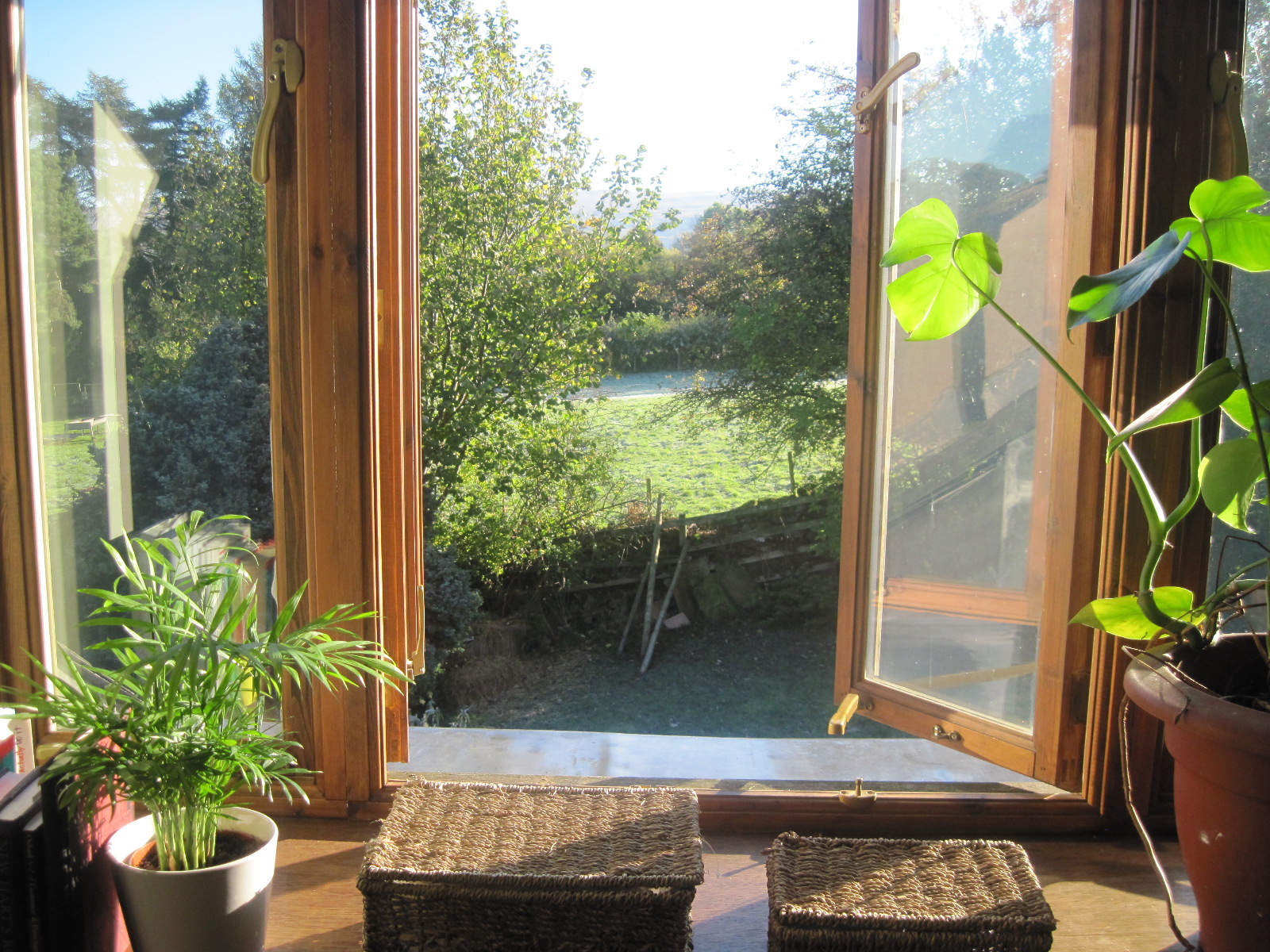
View from my writing room
All around me, the trees are letting go of their leaves. There is no waste, though. They will eventually rot down and become part of Mother Earth. I love the way she recycles everything. Though not a lover of the cold (or being cold), I do adore and celebrate the beauty and majesty of Winter, in particular the bare trees. I love how everything is stripped back to basics.
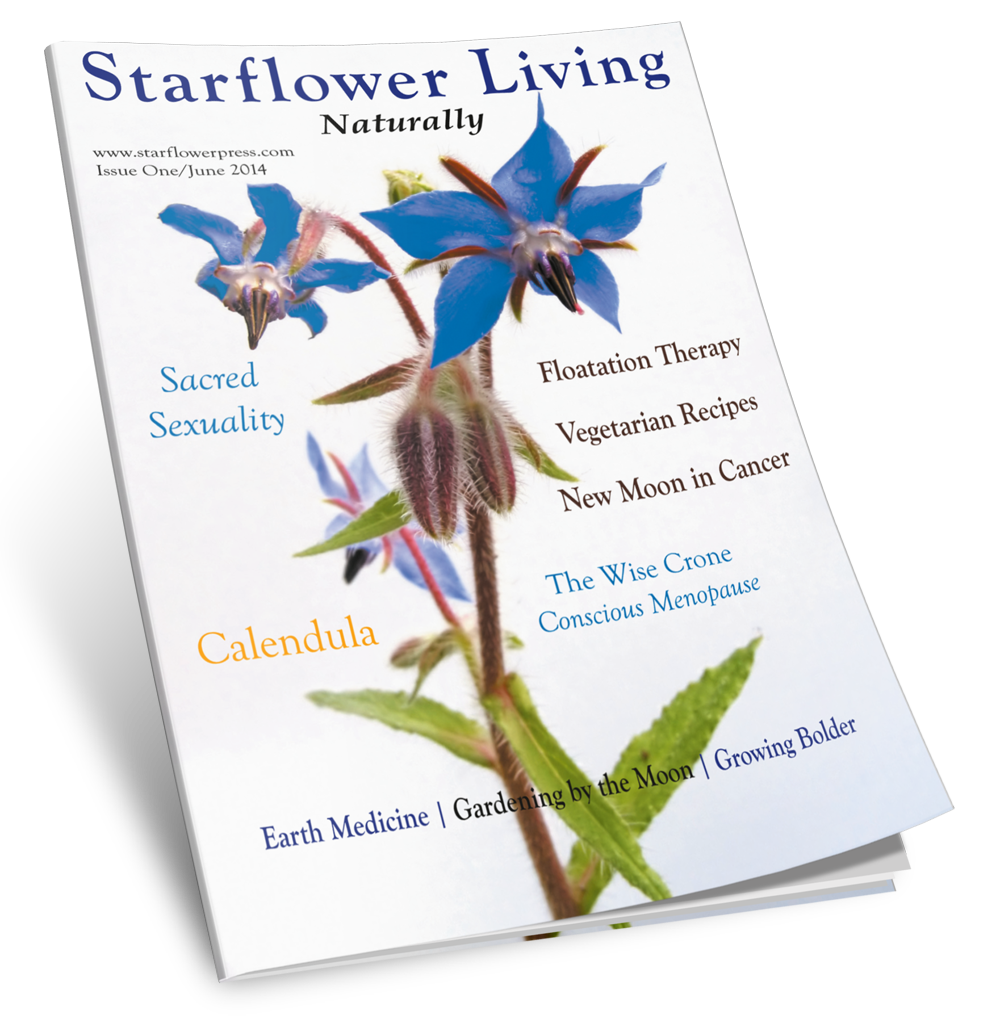
If you’ve not yet read issue 5 of my online magazine, Starflower Living, I write about grief as a time to withdraw from daily life. Clare Cooper writes about learning to let go. Samantha Parker explores the meaning of soul mates. And, with Halloween tomorrow, you might be interested in the origins of this tradition. It began as a celebration or festival of the wise grandmother. And there’s also a piece on the power of the burning bowl ceremony.
Just a reminder, too: Issue one of Starflower Living is available for free. Visit www.starflowerpress.com
How do we know when it is time to let go? I believe it is when something or someone or a situation no longer feels right or good to us. Letting go is like exhaling. Sometimes we need to take in a rather large amount of air first.
The decision to have our girl cat put down did not come quickly or easily. It was a painful time, but her needs were more important than ours. Like cleaning a room, the change in this home after she’d gone was huge. It wasn’t just because we missed her, but the energy her illness brought to this home was felt throughout. I hadn’t realised just how much until she was no longer here.
Energy is everywhere and in everything. This is why it is so important that we consciously purge negativity from our life on a regular basis. If it isn’t something that comes easily to you, then do use this time of year to release and let go.
At my desk
New Year’s Day is often seen as a time to make resolutions and goals, and yet, this time of year (to my mind) is pretty perfect. The veil between this world and the next is considered to be thin during Samhain/Halloween. It is a time to connect with our ancestresses. As we head into the darkest part of the year (here in the Northern Hemisphere), we can plant seeds of intention into the dark earth, trusting that they will germinate. First, though, we purge. We let go of all we don’t want from our lives, and then fill the vacuum with ‘good’ ideas, intentions, habits, people.
Right, I’m off to completely declutter the kitchen cupboards. And bake some pumpkin brownies!
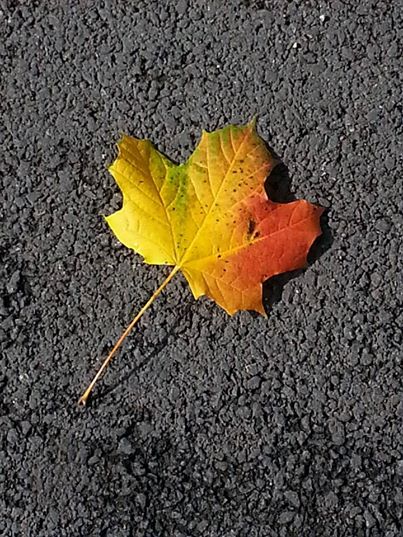
The was the first Autumn leaf of the year to catch my eye
https://veronikarobinson.com/wp-content/uploads/2025/04/Updated-logo-colour.png00Veronika Sophia Robinsonhttps://veronikarobinson.com/wp-content/uploads/2025/04/Updated-logo-colour.pngVeronika Sophia Robinson2014-10-30 16:24:032014-10-30 16:24:40Scorpio, the season of decay
I’m about to start putting together issue 5 of Starflower Living (a monthly online magazine).
The themes for this issue run alongside those of the New Moon in Scorpio: soul mates, sexuality, transformation, empowerment, letting go, old baggage, psychology, secrets, depth of character, compulsions, deep emotional connections, ancestors, debt, inheritance, jealousy, abandonment.
Health issues: sexual organs, organs of elimination, menstrual cycle, sexual infections.
The due date for articles, artwork, adverts and photos is tomorrow, October 4th. Please email your submission to me at: office (at) starflowerpress (dot) com or veronikarobinson (at) hotmail (dot) com
Before submitting, please be familiar with our publication. http://www.starflowerpress.com/living/index.shtml
https://veronikarobinson.com/wp-content/uploads/2025/04/Updated-logo-colour.png00Veronika Sophia Robinsonhttps://veronikarobinson.com/wp-content/uploads/2025/04/Updated-logo-colour.pngVeronika Sophia Robinson2014-10-03 08:46:062014-10-03 08:46:47Reaching for the Depths
On an Autumnal day in New Zealand in March, 1996, I gave birth to my first child at home in a birth pool by candlelight. Mozart’s music played in the room, and she arrived in this world peacefully. She didn’t cry or fuss, but just looked into our eyes and took in her surroundings.
Half an hour later, it was time to cut the cord (if I knew then what I do now, we’d have had a *lotus birth and not cut the cord). She howled and screamed. It has been said that cutting the cord doesn’t hurt, but she clearly felt ‘something’ as our physical connection was severed.
Seconds after giving birth at home, by candlelight and Mozart, to my daughter Bethany.
For eighteen years, we have shared our lives. At seven this morning, we waved goodbye. That umbilical cord was well and truly cut. And it bloody well hurt me too. She’s on her own now. This part of my mothering journey with her is over.
I’m no longer there to protect her, make sure she eats her greens, warn her off certain boys, and prompt a bedtime to ensure adequate sleep. My job is done.
I look forward to hearing all the stories about university life. But today, I grieve. Today I trust the tears which fall so freely to cleanse old wounds.
I have found it interesting in these past few weeks how differently people respond to pain. Those who have attachment parented their children ~ they understand. They allow me my grief without trying to band aid over it.
And then there are people who are quick to remind me that she’ll be home in ten weeks. It’ll zip by, they say. Maybe. But I doubt it.
If you ever miscarry, someone is bound to say ‘never mind, you can try again’ or ‘it wasn’t meant to be’…rather than just honouring the loss. They mean well, of course, but it doesn’t help.
Yes, Christmas might be just around the corner (at my age it’s always just around the corner!)…but that’s more than 150 meals we won’t be sharing together. More than seventy mornings where I won’t get to see her smile or share a cup of tea.
As a bonded family, every day is a lifetime to savour. So, in some people’s world ten weeks is nothing. This morning, for me, it is a long time away.
I appreciate she’s not going off to war or ill in hospital. She’s a beautiful, healthy young woman with adventures ahead of her ~ but that doesn’t make the cutting of the umbilical cord any less painful.
The eighteen years between giving birth and saying goodbye, now THAT has zipped by.